Bee-city in the castle park
The Adventures of Maya the BeeBee-city in the castle park is both the homeland of the Nation of Bees and the fortified setting of its defense against the Hornets. Identified by its colored portals and sheltered by a silver-fir, it is a place Maya recognizes as home and a community whose loyalty and organized resistance become decisive when invasion threatens.
Setting and Physical Form
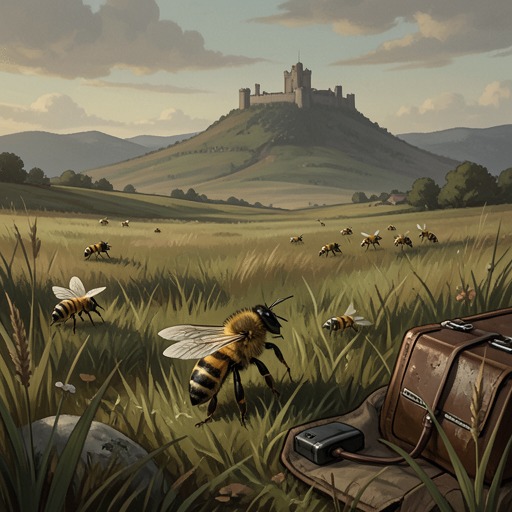
The Bee-city in the castle park lies in the castle park, where mighty lindens appear as grey domes in the dim light of dawn. Near a long stone wall stands a silver-fir that shields the Bee-city in the castle park against the west wind. These landmarks help Maya recognize her homeland as she returns in the early morning: she sees the tree, then the entrances, and flies toward the red one that leads to her people and Helen VIII.
The Bee-city in the castle park has red, blue, and green portals. The entrances make the city recognizable from outside and direct arrivals to distinct points of entry; the account identifies the red portal as Maya’s way back to her people and their queen. Within the Bee-city in the castle park, streets and corridors become the space through which the fighting moves when the Hornets penetrate the entrance. The setting thus has both a visible exterior, approached across the park, and an interior network that can be defended in depth.
Homeland and Political Boundary
Maya identifies herself as belonging to the Nation of Bees in the castle park, ruled by Helen VIII. For her, the city is more than a home address: news of her people revives her homesickness and the wish to do something good for her queen and country. After learning that the Hornets intend to attack, she is driven back toward the Bee-city in the castle park by that attachment, even while fearing that she may be punished for having left.
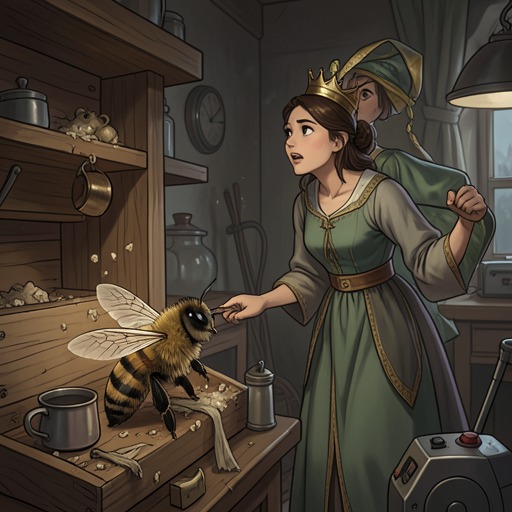
Entry is controlled. When Maya reaches the red entrance, two sentinels stop her and threaten her because she has tried to enter without the queen’s consent. The prohibition is treated as a capital offense, not a mere breach of etiquette: a bee cannot force entry into another city without permission. The sentinels release Maya only after she gives the password by which Bees recognize one another. In this scene, a familiar sign of belonging changes the outcome at the threshold, allowing an urgent return that might otherwise have been fatal.
Mobilization and Defensive Preparation
The Bee-city in the castle park is rapidly transformed from a home into a defensive position when Helen VIII learns that the Hornets plan to attack at dawn, plunder the city, and capture as many Bees as possible. The news causes alarm, but the preparations are not confused. Volunteers are called to defend the entrance, and scouts sent to watch for the enemy return with confirmation that the Hornets are approaching.
The Bees assemble in three closed ranks at the entrance, while officers arrange reserves behind them. The queen takes an elevated position inside the Bee-city in the castle park so she can survey the battle, and her aides move through the preparations. At the doorway, wax-generators work in silence to narrow the opening. Two thick wax partitions are raised, reducing the entrance by almost half and creating obstacles that even the strongest Hornets would take considerable time to break through. The entrance is therefore not only the point the enemy must cross; it is also a deliberately altered defensive structure.
The Battle Within the City
When the attack begins, the narrow entrance and the Bees’ reserve ranks shape the battle. The Hornets who get inside are forced farther down the dark streets and corridors, while fresh Bee soldiers replace those at the front. The defenders exploit the confined approach: when an exhausted Hornet appears to have an opening, the Bees let him advance, then confront him with rested ranks as the next attacker comes forward. This defense uses the city’s interior space to prevent the Hornets from turning their greater size and strength into an easy passage inward.
The fighting brings deaths and serious losses on both sides. A young Bee officer is the first to die, and his death intensifies the defenders’ willingness to fight; the Hornets’ attack also inflicts heavy casualties. But the Hornets’ numbers and strength do not settle the contest. Their retreat is cut off from the attackers outside, and their stings lose effectiveness over time, while the wounded Bees understand that they may recover and continue resisting. Gradually the noise subsides, and the Hornet leader orders the force outside to withdraw from the entrance. The attackers’ remaining numbers have fallen to half.
Significance of the City
The defense makes the Bee-city in the castle park an image of collective organization as well as a physical refuge. Its soldiers know their places, its reserves support the entrance, and its workers alter the doorway under orders. The city’s defenses depend not on a single barrier but on coordinated action, with the wax partitions slowing the invaders and the ranks inside turning that delay into an advantage.
The contrast between the Hornets’ greater individual power and the Bees’ unity is made explicit by an older Hornet, who recognizes that the Bees serve their people and state without turning traitor. The Bee-city in the castle park gives that unity a concrete form: its people gather at the threatened threshold and defend the community together. For Maya, whose return begins in homesickness and fear of punishment, the city is also the place where personal belonging becomes action in defense of others.